


Chinese Visa Photos — Guaranteed to Pass
China does not use the size Australia uses, and the photo you already own is almost certainly the wrong one. Photograph yourself at home and every rule the visa centre publishes is measured before you pay. Express delivery to you for free, tracking included.
Delivered by
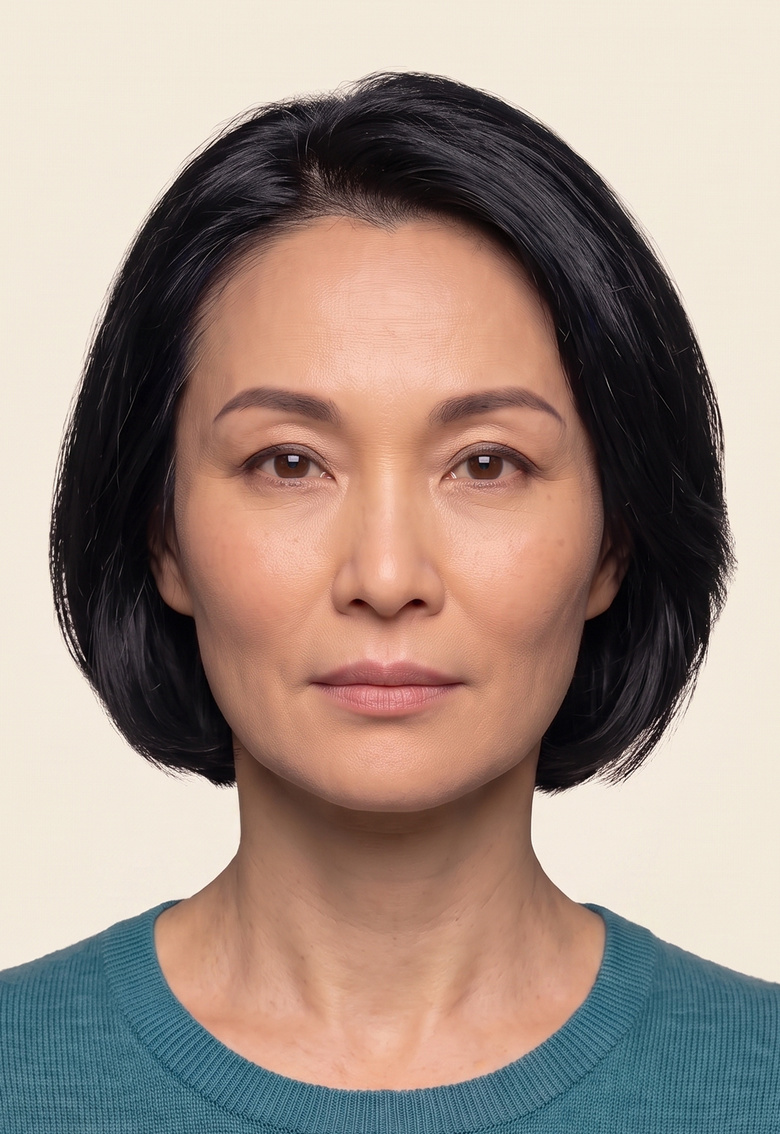
A Chinese Visa Photo must measure 33 mm wide by 48 mm high, on a white or close to white background. The face, measured from chin to crown, must be 28–33 mm. Your ears must be visible, your lips closed, and your eyes open and looking straight at the camera.
Checked against visaforchina.cn on 13 August 2026. Read the official guidance.

The rules, exactly as the visa centre publishes them
China states one exact size rather than a range, which is the first thing that catches people out: there is no tolerance to be inside. The photo must be 33 mm wide by 48 mm high, and within it your head must measure 28–33 mm from the chin to the crown.
The crown is the top of your skull, not the top of your hair. Measure to the hair on a tall or voluminous style and the crop you produce falls outside the permitted band — a small distinction with the whole application resting on it.
The background must be white or close to white, with no edge frame. Note how narrow that is next to what a passport photo allows: the light grey an Australian passport accepts is not white, and a photo taken against one on the day it was taken for something else will not do here. Every figure on this page is read from the visa centre's own published requirements and its measurement diagram, and carries the date we last checked it — nothing is rounded, reworded, or replaced with a house version.
Why the photo already in your drawer will not do
Almost every photo an Australian already owns was cut to the size Australia uses, because that is what a passport, a licence and a shop counter all produce. China uses neither that width nor that height, so the print is wrong in both directions at once and no amount of trimming rescues it — cut a photo down and the head inside it is now the wrong size for the frame around it.
Two rules go further than the passport office's, and they are the ones nobody is expecting. Both ears have to be visible, which a fringe or a bob quietly defeats. And the expression rule asks for lips closed, not merely unsmiling. One rule goes the other way: glasses are permitted here, provided they are not thick-rimmed, tinted, or catching a reflection.
| Photo size | 33 mm × 48 mm |
|---|---|
| Face height, chin to crown | 28–33 mm |
| Space above the head | 3–5 mm |
| Space below the chin | At least 7 mm |
| Background | White or close to white, with no edge frame |
| Head width | 15–22 mm |
| Expression | Neutral, with your lips closed |
| Ears | Both must be visible |
| Head tilt | Up to 20° left or right, and 25° up or down |
| Glasses | Permitted, unless thick-rimmed, tinted or reflecting |
| Head covering | Religious reasons only, and it must not obscure the face |
| Edge frame | Not permitted |
| Age of photo | Less than 6 months old |
| Paper | Glossy — not matte, and not plain paper |
| Condition | No creases, scratches or marks |
| How many | One photo, with the application |
Every reason a visa photo gets rejected, checked before you pay
The visa centre says plainly that an application may be declined if the photo does not satisfy its requirements, and that the responsibility is the applicant's. That is the whole risk of this document: the photograph is not judged at the counter in a way that lets you fix it, it is judged afterwards.
So every rule runs on every photo before there is anything to pay for. Head turned. Head tilted. Eyes closed. An expression that is not neutral. Glare on a lens. Somebody else in the frame. A background that is not plain. A shadow across the face. Hair over the eyes. Blur, grain, reduced resolution, a photo that is not in colour. Alongside them run the measurements — the size, the head height to the millimetre, the space above the head and below the chin, exposure and lens distortion.
If you order prints, a person checks the printed photo before it goes in the envelope. Not the file — the paper, which for this document has to be glossy rather than matte and has to reach the centre without a crease in it.
Three things the services selling Chinese visa photos get wrong
The most common is a flat statement that all glasses must come off. The visa centre's own wording permits them, ruling out only thick rims, tints and reflections — so a reader who owns a perfectly acceptable photo is told to retake it, by a service that has not read the requirement it is selling against.
The second is a shape. Several services describe this photo as a plain three-to-four portrait, which it is not; the real proportion is narrower, and cropping to the wrong one produces a print that is out by more than a millimetre in height. The third is a digital figure — a pixel limit and a file size — quoted as though the Australian centres published it. They do not. It appears on the Kuala Lumpur and Manila centres' pages, and we do not print it here as an Australian requirement for that reason.
What the centres do publish about the online form is what actually helps: if the upload fails three times, you are told to bring a physical photograph and the staff will scan it for you. Our price, what it includes, and how it compares to every service we have checked, all carry the date each figure was read.
Digital
High-resolution file, correctly cropped, ready to upload or print.
8 printed photos, delivered
Not available yet in Australia. The digital photo is ready to download the moment it passes; printing and postage are coming.
How to take it at home
Find a white wall, not a light grey one
Face a plain white or very near-white wall with nothing on it. This is stricter than a passport photo, which also accepts light grey — a wall that passed for your passport may be too dark here. Stand a good pace forward of it so your own shadow falls on the floor behind you rather than on the wall.
Put your hair behind your ears
Both ears have to be visible, and this is the rule Australians most often break because no Australian document asks for it. Tuck a fringe aside and move a bob back off the ears before you take the photo, rather than discovering the problem after the application has gone in.
Use the timer, and stand back
Prop the phone at eye height and use the self-timer rather than holding it at arm's length. A phone held close enlarges the nose and narrows the ears, and this specification names distortion as its own reason for refusal. Stand back, look straight at the lens, and let the crop do the rest.
Frequently asked questions
What size is a Chinese visa photo?
China requires 33 mm wide by 48 mm high, stated as one exact size rather than a range. Australia, the United Kingdom and most of the Commonwealth use a different size entirely, so a photo taken for an Australian passport is the wrong shape as well as the wrong dimensions.
Can I use my Australian passport photo for a Chinese visa?
No. The two documents use different sizes, and the Chinese one is narrower and taller. Trimming an Australian print down does not fix it either — cutting the paper leaves the head the wrong size inside the new frame, and head height is measured as strictly as the print is.
Can I wear glasses in a Chinese visa photo?
Yes, which surprises people who have just been told to take them off for a passport. The visa centre permits eyeglasses and rules out only three things: thick rims, tinted lenses, and glare. If the frames hide the eyes or the lenses catch the light, take them off; otherwise they may stay on.
Do my ears have to be visible in a Chinese visa photo?
Yes. The published requirement asks for the entire head and face to be clearly visible with the ears showing, and it is the rule Australians break most often, because no Australian document asks for it. Move a fringe aside and tuck longer hair back before you take the photo.
Does a Chinese visa photo need a white background?
The requirement is white or close to white, with no edge frame around the print. That is narrower than an Australian passport photo, which also accepts light grey — so a wall that was fine for your passport may be too dark for this, and a photo with a white border printed around it is refused outright.
Can I smile in a Chinese visa photo?
No. The expression has to be neutral, and the rule goes one step further than most: your lips must be closed, not merely unsmiling. Eyes open, looking straight at the camera, with the head centred and square on.
How many photos do I need for a Chinese visa application?
One photograph is submitted with the application. Because the online form also takes an uploaded copy, it is worth having the printed photo and the digital file agree — the same photograph, not two taken on different days.
Does a Chinese visa photo have to be printed on glossy paper?
Yes. The requirement names glossy photo paper and rules out matte finishes and plain paper, which is why a photo run off on an office printer is refused however good the image is. The print also has to arrive without stains, scratches or a crease in it.
How old can a Chinese visa photo be?
Less than six months. The point of the rule is that the photograph shows how you look now, so a good photo from last year is unusable no matter how well it meets every other requirement.
What happens if the online form will not accept my photo?
After three failed uploads the system stops you and tells you to bring a physical photograph to the visa centre, where staff will scan and upload it when you submit your application. Worth knowing before you spend an afternoon re-cropping a file that was never going to be accepted.
Does my child need their own photo for a Chinese visa?
A child applying in their own right needs their own form and their own photograph. Where a child travels on a parent's passport rather than holding one, a separate form is not required.
Can I wear a head covering in a Chinese visa photo?
Only for religious reasons. Where one is worn on that basis it must not obscure any facial feature, and the whole face has to remain clearly visible. Hats and other non-religious head coverings are not permitted at all.
Where do I lodge a Chinese visa application in Australia?
Applications go to a Chinese Visa Application Service Centre in person, and there are four in Australia — Sydney, Melbourne, Perth and Canberra. Which one takes your application depends on where you live, and the areas they cover have changed recently, so check the centre's own page before travelling to it.
Can I take a Chinese visa photo at home?
Yes. No rule requires a studio or a professional photographer, only that the finished photograph meets the specification. A phone camera has been sharp enough for years; what a counter gives you is a plain wall and somebody framing the shot, and both are reproducible in a hallway.
Can a Chinese visa photo be edited or retouched?
The photograph has to be in natural tone and free of distortion, which rules out filters, skin smoothing and anything that reshapes the face. We correct exposure and crop to the required dimensions; we never alter a background, a face, or clothing.